
Understanding Mantis Eyesight: Can They See in Colour?
Published on: February 12, 2026 | Last Updated: February 12, 2026
Written By: Rowan Hale
Hello there, mantis friend. Have you ever noticed your praying mantis carefully tracking your movements, its head tilting with an almost thoughtful curiosity? That captivating gaze hints at a visual world far different from our own.
The simple answer is yes, research strongly suggests praying mantises do see in colour, though their colour perception is uniquely tailored to their predatory lifestyle.
The full picture, however, is wonderfully complex and reveals just how specialised these insects truly are. We will explore the fascinating science behind their vision and what it means for you as a keeper.
- Mantises possess a type of colour vision, but it may not be as rich or varied as human sight.
- Their ability to see colour is crucial for hunting, camouflage, and even choosing mates.
- The structure of their remarkable compound eyes allows for a nearly 360-degree field of view.
The Anatomy of Mantis Eyes
Mantis eyes are fascinating structures that combine compound and simple eyes to give them a unique view of the world. Their large, bulging compound eyes are made up of thousands of tiny units called ommatidia, each acting like a miniature lens to create a mosaic image. This design allows mantises to detect movement with incredible precision, much like how we might spot a flicker in the corner of our eye. For a deeper look, a vision anatomy guide explains how mantises use their two large compound eyes along with smaller eyes to perceive depth and motion. These guides show how the different eye types work together to give mantises keen vision.
Alongside these, mantises have three simple eyes known as ocelli, positioned on their forehead. Ocelli don’t form detailed images but help mantises sense light intensity and direction, aiding in quick orientation during the day. When I watch my Ghost Mantis, Luna, she often uses her ocelli to adjust to shifts in light, making her movements seem thoughtful and deliberate.
Inside the compound eyes, photoreceptors and the retina work together to process visual information. The retina contains specialized cells with light-sensitive pigments that respond to different wavelengths, forming the basis for their potential color vision. This setup is similar to how a camera sensor captures various hues, but tailored for a mantis’s needs.
- Compound Eyes: Detect motion and provide a wide field of view, crucial for hunting and avoiding predators.
- Ocelli (Simple Eyes): Sense light levels and help with balance and rapid responses to changes in brightness.
- Photoreceptors: Absorb light and convert it into signals the brain can interpret, possibly for color discrimination.
- Retina: Houses the photoreceptors and processes visual data, acting as the eye’s internal screen.
How Mantises Detect Color
Mantises exhibit spectral sensitivity, meaning their eyes can pick up specific colors across the light spectrum. They show a strong ability to discriminate between hues, particularly in the green and ultraviolet ranges, which helps them navigate their leafy environments. This sensitivity isn’t just for show—it plays a role in everything from finding prey to choosing mates. That leads to the question: why do praying mantis eyes change color? Some researchers suggest that apparent color changes arise from light interacting with the eye’s microstructures, rather than permanent pigment shifts.
Ultraviolet perception is a standout feature, allowing mantises to see patterns on flowers or insects that are invisible to human eyes. This UV vision can reveal hidden details, like the subtle markings on a potential mate or the outline of camouflaged prey. In my experience with Moss, my Giant Asian Mantis, he’d often pause under UV light, as if studying something we can’t perceive.
Green sensitivity is another key aspect, tuned to the colors of plants where mantises often hunt. Their eyes are especially attuned to green wavelengths, making it easier to spot movement against foliage and ensuring they don’t miss a meal. This focus on green helps them blend in and strike with accuracy, much like a hunter in a dense forest. Diet and genetics shape coloration, influencing how well they blend into their surroundings. This in turn helps define their role as stealthy ambush predators.
- Light enters the eye and hits the photoreceptors in the retina, which absorb specific wavelengths based on color.
- Photoreceptors send signals to the brain, where they’re compared to determine differences in hue and intensity.
- The brain processes these cues to form a color perception, guiding behaviors like hunting or mating.
- This information is used to make quick decisions, such as distinguishing a harmless leaf from a tasty insect.
The debate around mantis color vision continues, with some studies suggesting limited abilities and others showing clear discrimination in experiments. Research indicates that while they may not see the full spectrum like humans, they can tell apart colors like blue and green in controlled tests. Evidence from lab settings, where mantises respond to colored stimuli, supports the idea that their vision is more nuanced than once thought.
Color Vision in Daily Mantis Life
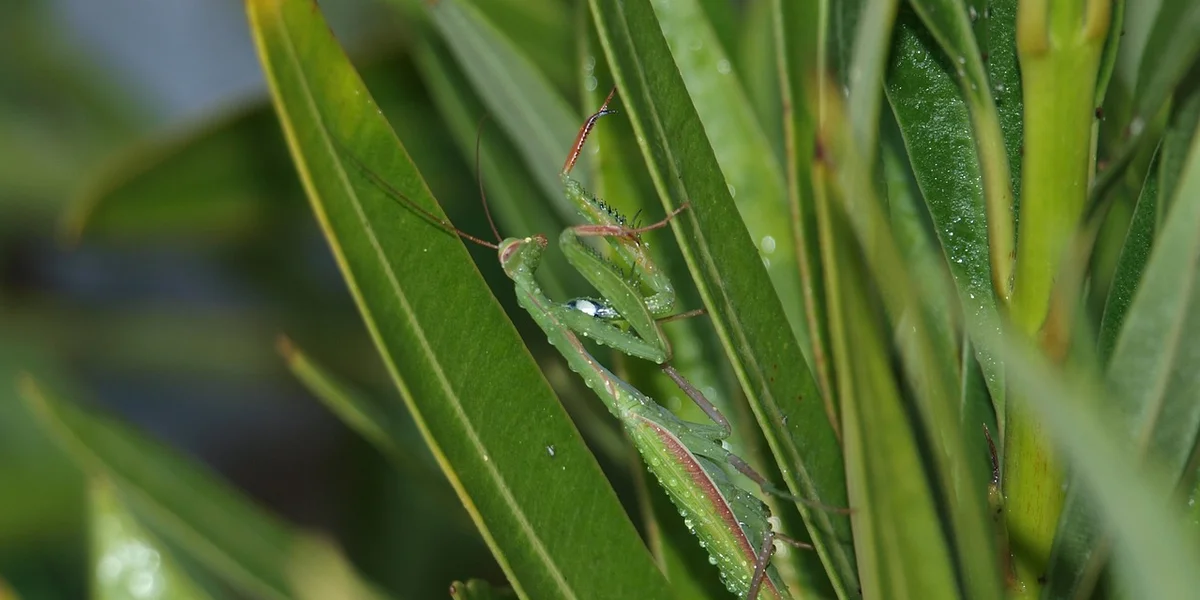
Mantises rely on their color vision to spot prey with surprising accuracy. Their ability to distinguish hues like greens and browns helps them pick out insects against cluttered backgrounds, making hunts more efficient. For instance, when Luna, our Ghost Mantis, notices a dark fruit fly on a light leaf, she often pauses, tilting her head to gauge the color contrast before striking.
In mating rituals, visual cues play a vital role in communication. Males may be drawn to females with specific color patterns, such as subtle shifts in shade that signal readiness to mate. We’ve seen Moss, our Giant Asian Mantis, approach potential mates more eagerly when their coloration stands out against the enclosure’s foliage.
Diurnal and Nocturnal Vision Differences
Diurnal mantises, active in daylight, use color vision extensively for hunting and navigation. Their eyes are tuned to detect motion and color in well-lit conditions, much like how we perceive a garden in full sun. Nocturnal species, however, prioritize motion detection over color in dim light, relying on heightened sensitivity to movement.
- Diurnal mantises: Excel in color discrimination for prey identification.
- Nocturnal mantises: Focus on motion cues, with color vision taking a backseat.
From visual ecology studies, mantises in the wild use these traits to blend in or stand out. Observing Sprig, our Orchid Mantis, shows how her pink-and-white marbling helps her ambush prey by mimicking flowers, a clever use of color in her daily life. It’s a perfect illustration of how a praying mantis’s color helps it survive through camouflage and mimicry.
Practical Care Tips Based on Vision
Proper lighting in your mantis enclosure supports their color perception and overall well-being. Use full-spectrum LED bulbs that mimic natural daylight, positioned to avoid direct heat on your pet. This setup helps mantises like Luna distinguish colors clearly, reducing hunting errors. Be aware of common lighting, heating, and humidity mistakes that many keepers make. Keep temperatures stable and humidity balanced to prevent stress and poor molts.
Using Color and Contrast in Habitats
Incorporate a variety of natural hues and contrasts to create a stimulating environment. Add live plants with different green shades and textured backgrounds to mimic their native habitats, which can ease stress and encourage natural behaviors. Avoid overly bright or monotone setups that might confuse or startle them.
- Choose enclosure backgrounds with muted earth tones.
- Introduce prey items that contrast with the surroundings for easier detection.
- Rotate decorative elements periodically to maintain visual interest.
Interpreting Behavior Through Visual Cues
Watch for subtle signs in your mantis’s actions to understand their visual needs. If your mantis frequently misses prey or avoids certain areas, it could indicate poor lighting or color mismatches in the habitat. Steps to assess this include noting head tilts, stalk movements, and feeding responses over time. If these signs persist, they’re a signal that the habitat may need adjustment. Fixing lighting, temperature, humidity, and hiding spots can help reduce stress and improve conditions for your mantis.
- Step 1: Observe how your mantis reacts to colored objects during feeding.
- Step 2: Track any avoidance of brightly lit or shadowy spots.
- Step 3: Adjust lighting or decor based on these observations.
Preventing stressors tied to vision involves maintaining consistent conditions. Sudden changes in light intensity or color schemes can disorient mantises, so use timers for gradual transitions and avoid flashing lights. In our experience, keeping Moss’s enclosure dimly lit in the evening helps him settle without visual overload.
Mantis Shrimp: A Colourful Comparison
Mantis shrimp possess some of the most complex eyes in the animal kingdom, equipped with up to 16 distinct types of photoreceptors that detect colours from ultraviolet to far-red light. Their visual system allows them to perceive polarised light and subtle colour gradients that are completely invisible to human eyes.
In contrast, praying mantises typically rely on trichromatic vision with just three photoreceptor types, focusing more on detecting movement and shapes than fine colour details. This difference highlights how mantis eyes are optimised for spotting prey against cluttered backgrounds, while mantis shrimp use colour for intricate social displays and hunting in vibrant coral reefs.
| Visual Feature | Mantis Shrimp | Praying Mantis |
|---|---|---|
| Photoreceptor Types | Up to 16 | 3 (trichromatic) |
| Spectral Range | Ultraviolet to far-red | Limited, similar to humans |
| Colour Discrimination | Extremely high, with polarisation detection | Moderate, prioritises motion |
Studying these visual systems sheds light on how insects evolved different strategies based on their habitats and behaviours. We see that mantis shrimp invested in colour richness for survival in colourful environments, whereas mantises developed keen motion sensors for stealthy predation.
FAQs on Mantis
How does the color vision range of mantis shrimp compare to humans?
Mantis shrimp can detect a broader spectrum, including ultraviolet and polarized light, which humans cannot see. This extended range allows them to perceive subtle color variations in their coral reef habitats that are invisible to us.
Are there common myths about mantis shrimp color vision that have been debunked?
Some claims suggest mantis shrimp see “more colors” than any animal, but research indicates they may not distinguish hues as finely as once believed. Their vision prioritizes rapid motion detection and polarization over high-resolution color discrimination.
What do discussions on platforms like Reddit reveal about mantis shrimp color vision tests?
Reddit threads often highlight experiments where mantis shrimp are trained to choose colored targets, demonstrating their unique abilities. However, these tests show that while they excel in detecting specific wavelengths, their color perception is tailored to ecological needs rather than being universally superior.
Embracing Your Mantis’s Colourful Perspective
Mantises see the world in vibrant shades, using colour vision to hunt and navigate their surroundings. Offering prey with natural colouration and keeping enclosures free from harsh, artificial lights helps them thrive in your care. Ensuring proper lighting and heating is crucial for their well-being.
We find great joy in watching our mantises respond to their environment, and it’s a keeper’s role to provide attentive, informed support. A mantis nervous system is highly specialized, making them perceptive and highly responsive. Understanding this can help you tailor care and enrichment for your pet insect. Stay curious about their unique traits and continue exploring resources to deepen your bond with these fascinating insects.
Further Reading & Sources
- Vision in Mantis Shrimp – Arts on the Brain
- A Different Form of Color Vision in Mantis Shrimp | Science
- Mantis shrimp have the most complex eyes in the animal kingdom. Here’s why – Discover Wildlife
- Colour vision in stomatopod crustaceans | Philosophical Transactions of the Royal Society B: Biological Sciences
Rowan Hale is a lifelong insect enthusiast who fell in love with mantises for their calm presence, alien elegance, and surprising personalities. After years of keeping and raising a variety of species, Rowan shares practical tips, creative insights, and real-world experience to help others enjoy the quiet magic of mantis care. From setting up the perfect enclosure to understanding their subtle behaviors, Rowan invites readers into a gentle, curious world where every tiny movement feels like a discovery.
Enrichment Activities