
History and Discovery of Praying Mantises
Hello fellow mantis friend,
Imagine a creature so still it resembles a leaf, yet so swift its strike is nearly invisible. This is the world of the praying mantis-a living paradox that has captivated humans for millennia.
The praying mantis boasts an ancient lineage stretching back 146 million years, with its name and symbolic meaning evolving across cultures from Greek oracles to Chinese martial arts.
Unravelling their full story is like piecing together a natural mosaic-each fragment reveals something new about their survival, symbolism, and scientific significance.
Here’s what we’ll explore together:
- Fossil evidence showing how mantises survived dinosaurs
- Ancient naming origins and what “mantis” truly means
- Cultural appearances in Greek mythology and Chinese folklore
- Key scientific discoveries that changed our understanding
- How their hunting style inspired human practices
My own Ghost Mantis, Luna, often reminds me of this heritage-her delicate, leaf-like frills mirror fossils from ages past, a living bridge to prehistoric worlds.
The Ancient Beginnings of Mantodea
Praying mantises trace their roots back over 100 million years to the Cretaceous period, a time when dinosaurs roamed and flowering plants began to flourish. Through their evolution, mantises developed an incomplete metamorphosis, with nymphs resembling tiny adults that molt into winged or wingless adults.
Their ancient lineage shows how these insects evolved from shared ancestors with cockroaches, developing unique predatory traits that set them apart.
Fossil records first document the order Mantodea in the Early Cretaceous, with remarkable finds like Santanmantis axelrodi from Brazil offering glimpses into early mantis forms.
Key fossil milestones include well-preserved specimens from amber deposits, which reveal mantises had already perfected their stealthy hunting posture millions of years ago.
Close relatives of modern mantises include cockroaches and termites, all belonging to the superorder Dictyoptera.
- Cockroaches: Share similar body plans but differ in diet and behavior.
- Termites: Highlight social versus solitary insect lifestyles.
- Other ancient insects like stick insects: Demonstrate convergent evolution in camouflage.
Knowing these relationships helps us appreciate why pet mantises thrive on live prey and require minimal social interaction, reflecting their solitary evolutionary path.
Historical climate shifts, such as ice ages and warming periods, spurred mantis diversification into various forms.
This adaptability means pet mantises can often adjust to minor changes in home environments, but we must still mirror their ancestral conditions for optimal health.
Geographic Spread and Habitat Adaptation
Praying mantises likely originated in the warm, humid regions of ancient Gondwana, before spreading across continents through natural dispersal and later human trade. Today, their natural habitat distribution reflects this history of dispersal. They are most commonly found in warm, vegetated environments where camouflage and predation are favored.
Their journey from tropical origins to global presence underscores why many species do well in captivity with careful habitat replication.
Over millennia, mantises adapted to diverse habitats, from rainforests to deserts.
- Asian mantises, like Hierodula species, evolved in lush forests and now thrive worldwide due to their resilience.
- Desert-dwelling species developed lighter colors and water-conserving behaviors.
- Temperate zone mantises, such as Mantis religiosa, hibernated as egg cases to survive cold winters.
These adaptations directly influence pet care; for instance, my Ghost Mantis Luna needs higher humidity to mimic her Asian woodland home, while others prefer drier setups.
Understanding a mantis’s native environment guides enclosure design, including humidity levels, ventilation, and foliage. When choosing a mantis to keep, select an enclosure that matches the species’ habitat, since different species have distinct needs.
We often use simple household items like spray bottles for misting, creating microclimates that echo their ancestral habitats.
Key species like Mantis religiosa spread from Europe to the Americas, becoming popular in pet keeping due to their hardiness and striking appearance. Their unique characteristics, such as raptorial forelegs for catching prey and excellent camouflage, make praying mantises so special.
Their widespread success reminds us that even common mantises deserve enclosures tailored to their specific geographic roots for a thriving life.
Evolutionary Changes From Ancient to Modern Mantises
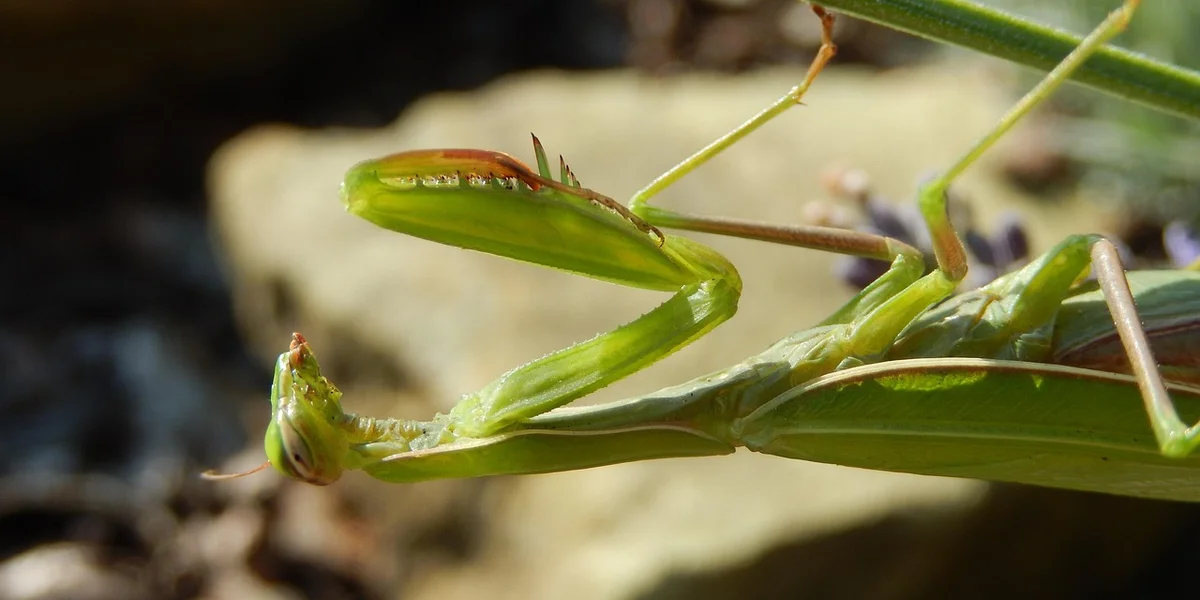
Ancient mantises roamed Earth over 100 million years ago, sporting broader bodies and less specialized limbs compared to today’s sleek hunters. Fossils show that early species like those from the Cretaceous period had simpler raptorial legs, which gradually evolved into the precise, spiked tools modern mantises use to snatch prey in a blink. Their behavior shifted from generalist predators to masters of ambush, adapting to diverse ecosystems from rainforests to deserts.
Characteristic features like camouflage and raptorial legs define Mantodea through history. Camouflage evolved from basic color matching to intricate shapes mimicking leaves or flowers, helping mantises avoid predators and surprise meals. Raptorial legs became more jointed and powerful, allowing pet mantises like my Ghost Mantis, Luna, to grasp insects with astonishing accuracy during feeding time.
- Santamanitis: An extinct genus from Brazil, revealing early forms of spiny forelegs that hint at modern hunting efficiency.
- Cretomantis: Fossilized in amber, this genus shows primitive body structures that later refined into the slender profiles we see in pets like the Giant Asian Mantis.
- Jersimantis: Known from Jurassic fossils, it highlights how mantises developed longer thoraxes for better mobility in dense vegetation.
These evolutionary transformations explain why pet mantises exhibit specific behaviors, such as their patient stalking or sudden strikes. Modern species have honed these traits over eons, so when your mantis waits motionless for prey, it’s tapping into an ancient survival strategy perfected through generations. Observing my own mantis, Moss, I see how his energetic hunts mirror the adaptability that helped his ancestors thrive.
Human Discovery and Cultural Significance
Mantises have fascinated humans for centuries, appearing in ancient texts like those by Pliny the Elder, who noted their “praying” posture as a sign of wisdom. The distinctive forelegs folded in a prayer-like position gave rise to the common name praying mantis. The name directly reflects this iconic posture, linking the insect’s appearance to its nickname. In many cultures, mantises symbolize patience and good fortune, enriching the pet-keeping experience by connecting daily care to deeper meanings. Early European explorers documented them in scientific illustrations, capturing their delicate forms and behaviors for future study.
European discovery in the 17th and 18th centuries boosted entomology, with figures like Carl Linnaeus classifying mantis species and laying groundwork for modern taxonomy. Linnaeus’s detailed descriptions helped standardize how we identify and care for pet mantises today, ensuring we recognize their unique needs based on species traits. Scientific art from this era, like detailed engravings, allowed keepers to appreciate the subtle variations in mantis anatomy.
Knowing this history adds richness to pet routines; for instance, I often reflect on mantis symbolism whilst misting Sprig’s enclosure, seeing it as a moment of calm mindfulness. Early anecdotes of mantises in folklore, such as their role in African tales as clever tricksters, remind us that these insects have long been companions in human imagination. This cultural backdrop makes feeding or handling your mantis feel like part of a timeless tradition.
- Key figures like Linnaeus: His work cataloging mantis species provided a foundation for understanding their diversity, which aids in selecting the right pet species for beginners.
- Scientific illustration: Early drawings highlighted mantis camouflage and posture, helping modern keepers spot health issues or natural behaviors in their pets.
Scientific Classification and Naming
Our delicate green hunters carry scientific identities shaped by centuries of observation. Carl Linnaeus laid the foundation in his 1758 Systema Naturae, grouping mantises with crickets and grasshoppers under the genus Gryllus before later establishing Mantis.
The Evolution of Binomial Naming
Early naturalists recognized these insects deserved their own designation. Johann Christian Fabricius expanded the system, describing new species while Pierre André Latreille later established Mantodea as a distinct order. Each scientist contributed layers of precision to how we classify these remarkable creatures today.
Understanding Insect Taxonomy
Modern mantis classification reflects continuous refinement through careful study. Taxonomic revisions have split original groupings into finer families like Mantidae, Hymenopodidae, and Empusidae based on physical traits and genetic evidence. What was once broadly “mantis” now reveals intricate evolutionary relationships, especially when compared to their close relatives.
Why Family Names Matter for Pet Owners
Knowing your mantis’s family provides immediate care insights before you even research the species. Mantidae species often prove hardy and adaptable, while delicate Hymenopodidae like orchid mantises require precise humidity and specialized enclosures. This historical classification system directly informs modern husbandry practices.
Choosing Your Mantis Using Historical Classification
- Start with family characteristics – research general care needs for Mantidae versus other families
- Compare species within your chosen family – observe size, temperament, and lifespan differences
- Consider historical distribution patterns – species from similar regions often share environmental preferences
- Match species traits to your experience level – beginners thrive with historically well-documented, resilient species
- Verify current classification – ensure care advice aligns with the most recent taxonomic understanding
This methodical approach using historical taxonomy helps prevent mismatches between keeper capability and mantis requirements. Our Ghost Mantis Luna, with her leaf-like frills, belongs to a family known for gentle temperaments – information that guided our initial selection perfectly.
FAQs on Mantis
What major extinct genera are known from Mantodea?
Extinct genera like Santanmantis and Jersimantis provide key insights into early mantis forms from the Cretaceous and Jurassic periods. Understanding these ancestors helps pet owners appreciate the evolutionary traits that influence modern mantis behavior and care needs.
How has climate change historically influenced mantis diversity?
Historical climate shifts, such as ice ages, drove mantises to diversify into species adapted to various environments like forests and deserts. This adaptability means pet mantises can often handle minor habitat fluctuations, but replicating their native conditions ensures better health in captivity. Different mantis species live in a range of habitats—from tropical forests in Asia to arid deserts in Africa. Knowing a species’ natural home helps tailor its enclosure and care.
What characteristic features define Mantodea through its history?
Raptorial forelegs and sophisticated camouflage have been hallmarks of mantises for millions of years, aiding in their survival as ambush predators. Coloration, often green, brown, or leaf-like patterns, enhances camouflage and can function as mimicry, helping mantises blend into their surroundings and survive. These traits make pet mantises captivating to watch during feeding, as they use ancient strategies honed through evolution.
Bringing History to Life in Your Home
From their ancient origins, we see that mantises thrive when we mimic their natural habitats with proper humidity and climbing spaces. Their evolutionary traits remind us to offer live prey and gentle handling to support their health and instincts, along with essential habitat requirements.
As pet owners, we hold the responsibility to provide attentive, kind care that respects their unique needs. Keep exploring care guides and observing your mantis to build a trusting, lifelong bond filled with learning, especially when handling them gently and understanding their behavior.
Further Reading & Sources
- Mantis – Wikipedia
- Five fast facts about easy-to-miss praying mantises | Forest Preserve District of Will County
- An exceptionally preserved 110 million years old praying mantis provides new insights into the predatory behaviour of early mantodeans – PMC
- “The Origins, Evolution, and Phylogeny of the Praying Mantises (Dictyop” by Gavin John Svenson
Rowan Hale is a lifelong insect enthusiast who fell in love with mantises for their calm presence, alien elegance, and surprising personalities. After years of keeping and raising a variety of species, Rowan shares practical tips, creative insights, and real-world experience to help others enjoy the quiet magic of mantis care. From setting up the perfect enclosure to understanding their subtle behaviors, Rowan invites readers into a gentle, curious world where every tiny movement feels like a discovery.
Common Species