
The Mantis Mind: How Smart Is Your Pet Insect?
Published on: February 13, 2026 | Last Updated: February 13, 2026
Written By: Rowan Hale
Hello, fellow mantis friend. Have you ever watched your mantis slowly turn its head to track a fly, its gaze so deliberate it feels almost human, and wondered what’s really going on inside that tiny, triangular head?
Your praying mantis possesses a unique and sophisticated intelligence, a specialised problem-solving ability honed by evolution to be a perfect predator, not a simple automaton. Their cognitive world is far richer than the simple “stimulus-response” machine we often imagine insects to be.
Unravelling the mantis nervous system is a fascinating puzzle. It challenges our very definition of intelligence, moving beyond just memory or tool use. We explore a consciousness built on hunting, survival, and spatial awareness. Here’s what we’ll uncover:
- The specialised brain structures that give mantises their legendary hunting prowess.
- Their surprising capacity for learning and memory, demonstrated in scientific labs.
- How their unique 3D vision creates a complex map of their world.
- The subtle, intelligent behaviours you can observe in your own terrarium.
What Is the Mantis Nervous System?
-
The mantis nervous system acts like a tiny, efficient control centre, directing all its actions from hunting to hiding. It’s the insect’s internal network that processes information and coordinates responses in real time.
-
Key parts include the brain, ganglia (clusters of nerve cells), a nerve cord running along the body, and sensory organs like eyes and antennae. Together, these elements form a streamlined system for sensing and reacting to the world.
-
This system manages basic functions such as limb movement, environmental sensing, and instinctive behaviours. It enables your mantis to prowl, perch, and pounce with graceful precision.
Where Is the Nervous System Located in a Mantis?
-
The brain resides in the head, while ganglia are positioned along the body segments, linked by a central nerve cord. Imagine it as a central hub with branching pathways that relay signals to every limb and organ.
-
We often picture it like a garden’s root system, with the brain as the core and nerves spreading out to monitor touch, sight, and movement. This layout allows for quick, localised reactions without delay.
Facts About the Praying Mantis Nervous System
-
Mantises possess roughly 1 million neurons, a modest count compared to mammals, yet they achieve feats like 3D vision and rapid strikes. Their nervous system is fine-tuned for survival, with adaptations that make them master ambush predators.
-
From caring for Luna, my Ghost Mantis, I’ve seen how her nervous system allows her to remain motionless for hours, then strike in a blur. Her calm demeanour masks a highly responsive neural network that calculates every move.
How the Mantis Brain and Nerves Function
-
Neurons and ganglia collaborate to enable swift reflexes, with ganglia handling routine tasks so the brain can focus on complex decisions. This teamwork results in lightning-fast reactions, like dodging threats or seizing prey.
-
Sensory processing involves compound eyes for detecting motion, ocelli for light sensitivity, and receptors on antennae and legs for touch and smell. These tools let your mantis interpret its surroundings with astonishing clarity.
Sensorimotor Integration in Action
-
Mantises use mechanoreception to feel vibrations through their legs and body, sensing nearby movement. This ability lets them detect a cricket’s faint footsteps or a breeze shifting leaves.
-
Chemoreception allows them to detect chemical cues with their antennae, identifying prey or potential mates. It’s like having a built-in scent tracker that guides their every choice.
-
This sensory input translates into precise movements, such as the iconic strike that captures insects mid-air. Watching Moss, my Giant Asian Mantis, I’ve marvelled at how he blends sensing and action into one fluid motion.
The Role of Optic Lobes and Vision
-
Compound eyes and optic lobes work together to process visual cues, enabling mantises to judge distance, track movement, and camouflage effectively. Your mantis can spot a drifting fruit fly from across the enclosure, thanks to this advanced visual processing.
-
In pet mantises like Sprig, the Orchid Mantis, you might notice her tracking your hand or a feeder with intense focus. This behaviour showcases how her optic lobes turn visual data into hunting success.
Mantis Intelligence: Learning, Memory, and Problem-Solving
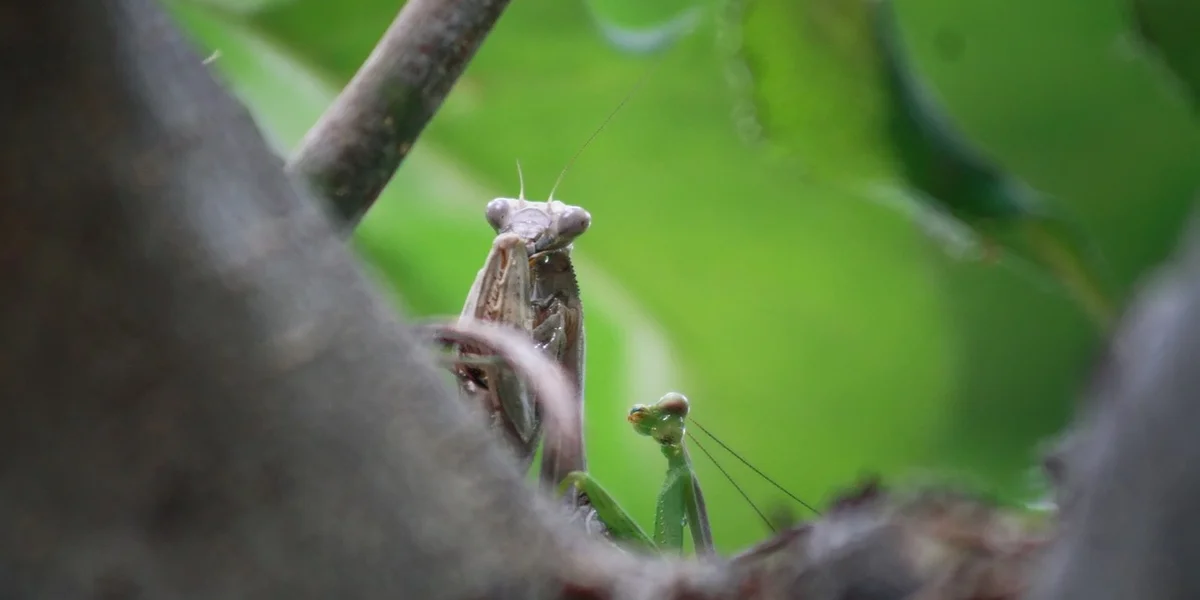
We often see our mantises as miniature predators with fixed routines, but their tiny brains hold surprising capacity for learning and adaptation. In nature, praying mantises help control pests, shaping insect communities and supporting ecosystem balance.
Evidence from controlled maze experiments shows mantises can learn complex routes and retain this spatial memory for several days. They don’t just rely on instinct-they build mental maps of their surroundings.
In courtship and predation, mantises display sophisticated decision-making, weighing risks against potential rewards before committing to action. For males, the risk of being eaten during mating shapes their courtship tactics. They adjust approach and signaling to balance mating success with survival.
A male mantis will carefully assess a female’s posture and movements, deciding when it’s safe to approach.
Can Mantises Learn and Remember?
In captivity, you might notice your mantis adapting its behavior based on past experiences.
Many keepers report their mantises learning to associate their presence with feeding time, becoming more alert and active when they approach the enclosure. This behavior is a common focus in a praying mantis feeding schedule species comparative guide, which compares how different species respond to feeding cues and meal timing. Such guides help keepers tailor schedules to each species’ natural prey cycles.
My Ghost Mantis, Luna, would tilt her head and track my movements specifically, unlike her reaction to other household activity.
She learned that my gentle tap on the enclosure lid often meant food was coming, showing clear anticipation.
Problem-Solving Behaviors in Pet Mantises
- Watch how your mantis navigates enclosure obstacles like branches or decorative elements. They don’t just push through-they assess and choose paths of least resistance.
- Note their hunting technique when prey hides. They’ll use trial and error, changing angles and approaches until successful.
- This behavioral flexibility relates directly to insect brain plasticity-their nervous system can form new connections based on experience.
Your mantis’s problem-solving abilities demonstrate a basic form of insect cognition that goes beyond pure instinct.
Comparing Mantis Neurobiology to Other Insects
While all insects share basic nervous system structures, mantises have unique adaptations for their predatory lifestyle. These unique characteristics—including triangular heads, rotatable eyes, and powerful forelegs—help explain what makes praying mantises so special.
The mantis brain allocates more processing power to visual information and motor coordination than many other insects. This supports their precise striking ability.
| Feature | Mantis | Ant | Spider |
|---|---|---|---|
| Brain Neurons | ~1 million | ~250,000 | ~100,000 |
| Ganglia Organization | Concentrated visual processing | Distributed for colony communication | Segmented for web-building |
| Key Behaviors | Individual hunting, camouflage | Collective problem-solving | Web engineering, vibration sensing |
Mantis vs. Ant Nervous Systems
Ant nervous systems are optimized for social coordination and chemical communication within large colonies.
Mantis neuroanatomy supports solitary hunting with enhanced visual processing and precise motor control for capturing fast-moving prey.
This difference explains why mantises don’t benefit from social interaction like ants do-their intelligence is geared toward individual survival.
For pet care, this means your mantis thrives in an environment that stimulates its natural hunting behaviors rather than social needs. Our complete care, handling, and behavior guide for pet praying mantises offers practical, step-by-step tips on safe handling, feeding, and enrichment to support this lifestyle.
What Makes Mantises Unique?
Mantises possess specialized neural pathways for depth perception and strike coordination that few other insects match.
Their nervous system supports incredible camouflage abilities, allowing them to remain motionless for hours while processing environmental information.
This affects their care as pets-they need visual complexity in their enclosure and opportunities to practice their natural hunting sequences.
Provide varied perches and occasional novel elements to keep their problem-solving skills engaged and their nervous system stimulated.
Implications for Your Pet Mantis Care
-
Knowing how your mantis processes information through its nervous system transforms routine care into a mindful practice. Their reliance on tactile and visual cues means sudden environmental shifts can overwhelm their simple ganglia, so we keep enclosures stable and predictable. This insight helps us avoid startling them with quick hand movements or loud noises during feeding or maintenance. Handle them slowly and gently, letting them decide when to climb or perch, as outlined in our guide on [handling and interacting with your praying mantis safely](https://mypetmantis.com/how-to-handle-and-interact-with-your-praying-mantis-safely). Keep movements smooth and predictable to minimize stress during any interaction.
-
Enrichment tailored to their cognitive level nurtures their natural curiosity without causing stress. We focus on activities that engage their instinctual behaviors, like hunting and exploring, which align with their ability to learn from repetition. Offering varied stimuli in small, manageable doses supports their well-being and keeps them actively engaged.
Enrichment Ideas to Stimulate Your Mantis
-
Introduce varied perches and hiding spots to encourage exploration. Adding twisty vines, smooth branches, or even artificial leaves gives your mantis new angles to survey its world, much like Moss eagerly climbing fresh greenery in his home. Rotate these elements weekly to mimic natural changes and spark investigative behavior.
-
Use live prey to engage their hunting instincts. Watching a mantis track and capture moving insects like fruit flies or small crickets provides mental stimulation that mirrors wild foraging. This practice hones their coordination and satisfies innate predatory drives in a controlled setting. Observe how they judge distance and adjust their posture before pouncing, which reveals the depth of their hunting behavior.
-
Rotate enclosure layouts to promote problem-solving. Gently rearranging decor every few weeks challenges your mantis to reorient itself, fostering adaptability without distress. We’ve seen Luna pause thoughtfully before navigating a newly placed twig, her head tilting as she assesses the change.
Handling Tips Based on Nervous System Sensitivity
-
Advise on gentle handling to avoid stress from mechanoreception. Their bodies are finely tuned to detect vibrations and pressure, so we use slow, deliberate motions when lifting them onto a hand or stick. Avoid grasping their delicate legs or abdomen, as this can trigger a defensive response and heighten anxiety.
-
Share personal experiences with mantises like Sprig responding to touch. When Sprig, our orchid mantis, feels a soft finger stroke along her back, she often settles into a calm stillness, her petals seeming to relax under warm light. This gentle interaction builds trust over time, showing how patience rewards both keeper and insect.
Monitoring Health Through Behavior
-
Explain how changes in behavior might indicate nervous system issues. Sluggish movements, refusal to eat, or erratic twitching can signal stress, injury, or underlying health problems affecting their neural function. For instance, a mantis that stops responding to prey might be experiencing sensory overload or physical discomfort.
-
Suggest simple observations for early detection of problems. Note daily routines like perching spots and feeding responses; shifts in these patterns often provide the first clues to nervous system distress. We regularly check for consistent alertness and coordination, as these reflect a healthy, well-functioning mantis mind. You can find more tips on monitoring your praying mantis’s health to catch any issues early.
Questions from Fellow Mantis Friends
Where can I find the praying mantis nervous system pdf?
You can access scientific papers on the praying mantis nervous system through online academic databases like Google Scholar or JSTOR. Many universities and research institutions also offer free or paid access to detailed PDF resources for further study.
What is the nervous system of an ant?
The nervous system of an ant includes a brain and a series of ganglia linked by a ventral nerve cord. It processes sensory inputs and controls essential functions like movement, communication, and social behaviors within the colony.
How does the nervous system influence ant behavior?
The ant’s nervous system enables coordinated actions such as foraging and nest building through rapid signal transmission. It interprets chemical cues to guide trail following and collective decision-making for survival.
Your Mantis’s Mind: A Gentle Recap
Observe your mantis’s daily habits and subtle reactions to understand their unique problem-solving abilities. Provide a habitat with climbing branches and varied feeding spots to support their natural instincts and mental engagement. To create a naturalistic, safe habitat for your praying mantis, mimic its wild environment with safe plants and sturdy perches. Keep the enclosure well-ventilated and maintain appropriate humidity to reduce stress.
Always prioritize a calm, clean environment to reduce stress and promote your mantis’s well-being. Regularly clean and maintain your mantis habitat to prevent mold and pests. We encourage you to keep learning through trusted resources and fellow keepers, deepening your connection and care over time.
Further Reading & Sources
- Praying Mantis, The Best Pet Insect? Navigate To These …
- r/Entomology on Reddit: How intelligent are Mantises?
- Apparent Motion Perception in the Praying Mantis: Psychophysics and Modelling – PMC
- Is the praying mantis the smartest insect? – Quora
Rowan Hale is a lifelong insect enthusiast who fell in love with mantises for their calm presence, alien elegance, and surprising personalities. After years of keeping and raising a variety of species, Rowan shares practical tips, creative insights, and real-world experience to help others enjoy the quiet magic of mantis care. From setting up the perfect enclosure to understanding their subtle behaviors, Rowan invites readers into a gentle, curious world where every tiny movement feels like a discovery.
Enrichment Activities